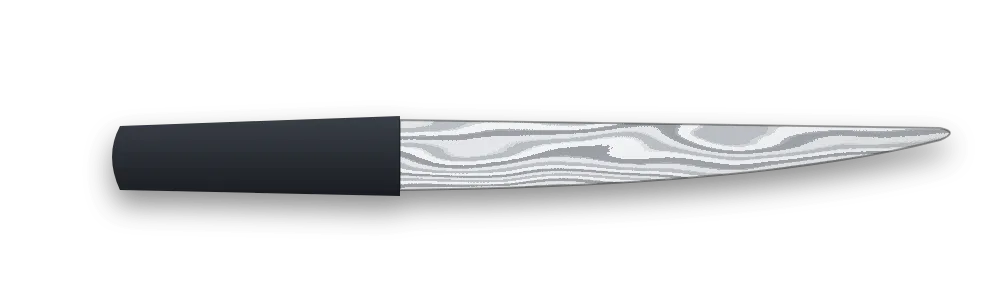
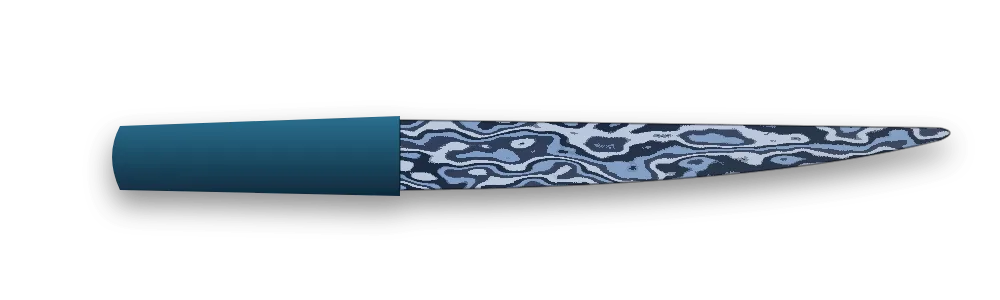
Why stainless Damascus for fish
Fish and salt water attack carbon steel quickly. A stainless Damascus fillet knife resists rust, tolerates a rinse on the boat and still shows its pattern. Flex comes from the thin grind and a slightly lower hardness (56–58 HRC) so the blade bends along a backbone instead of snapping.
Retailers selling to anglers should pair the knife with a ventilated sheath that lets the blade dry.
How we verify Damascus fillet knives
Every design in this collection is genuinely pattern-welded. Before a batch ships we pull samples and check four things: that the pattern runs over the spine and into the edge bevel, that an etch shows no open welds or inclusions, that Rockwell hardness matches the spec sheet, and that fit and finish meet the standard for the price tier. The results are recorded against the batch so reorders match.
Ask for spec sheets on any design above — they list the steels, layer count, hardness, dimensions, handle materials and packaging, plus UK and US market notes.
Questions buyers ask
Is a Damascus fillet knife flexible?
A good one is: thin stainless Damascus at 56–58 HRC flexes along the bones. Thick or very hard Damascus blades are too stiff for filleting.