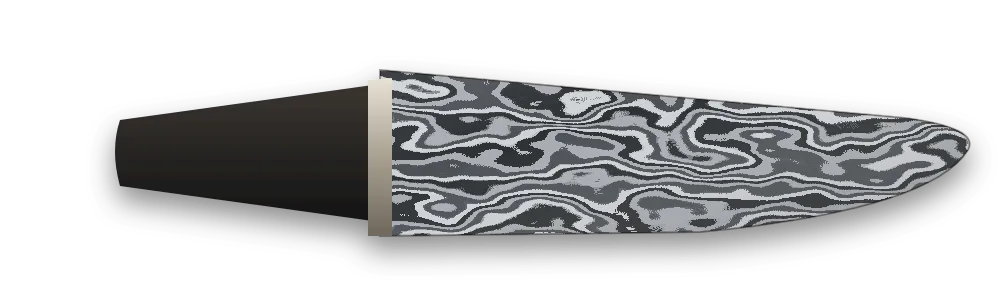
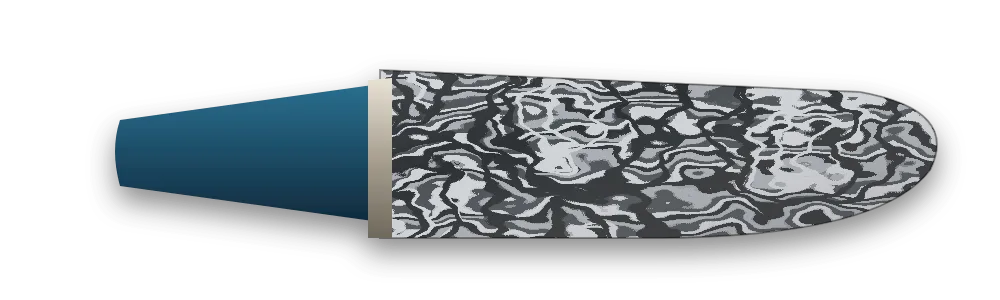
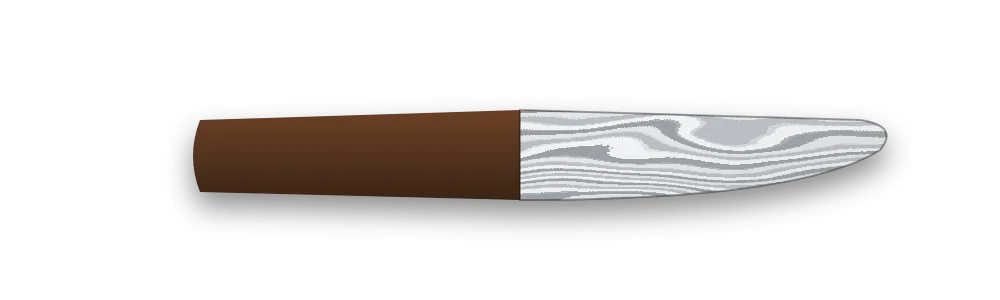
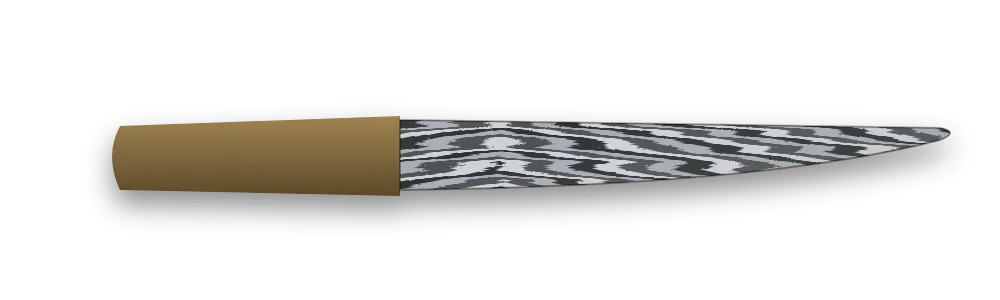
Core steel matters more than the pattern
Kitchen knives are where Damascus marketing is most misleading. On most modern kitchen knives, the Damascus is cladding: soft and hard stainless layers forged around a single hard core that forms the edge. That is a good design — the soft outer layers absorb shock while the core takes a keen edge — but it means you should judge the knife by its core.
| Core steel | Typical hardness | Character |
|---|---|---|
| VG10 (stainless) | 59–61 HRC | Sharp, low-maintenance, the most common premium choice |
| AUS-10 (stainless) | 58–60 HRC | Tough and easy to sharpen |
| High-carbon (e.g. 1095, White/Blue paper) | 60–63 HRC | Sharpest edge, needs drying and oiling, develops patina |
| Full carbon Damascus (no core) | 58–60 HRC | Pattern runs through the edge; reactive to acidic food |
The kitchen line-up
- Chef knife / gyuto (8–10 in) — the everyday cooking knife: slicing, dicing and rock-chopping.
- Santoku (6.5–7 in) — flatter profile for push-cutting vegetables.
- Paring knife (3–4 in) — peeling, trimming and in-hand work.
- Bread knife (8–9 in, serrated) — Damascus serrations are ground after the pattern is etched, so the pattern stays visible.
- Carving knife (8–10 in) — long, narrow blade for roasts and poultry; often sold with a carving fork.
Looking for sets, steak knives, cleavers or fillet knives? See Damascus knife sets, steak knives, cleavers and fillet knives.
Is Damascus steel good for kitchen knives?
Yes — when it is real, layered steel with a properly hardened core. Damascus kitchen knives are not automatically sharper than plain-steel knives; the advantages are a tough, slightly textured blade face that helps food release, excellent edge retention from the core steel, and a finish customers value. The disadvantages are price and, for carbon Damascus, extra care. See are Damascus knives good? for the full pros and cons.
How we verify Damascus chef knives
Every design in this collection is genuinely pattern-welded. Before a batch ships we pull samples and check four things: that the pattern runs over the spine and into the edge bevel, that an etch shows no open welds or inclusions, that Rockwell hardness matches the spec sheet, and that fit and finish meet the standard for the price tier. The results are recorded against the batch so reorders match.
Ask for spec sheets on any design above — they list the steels, layer count, hardness, dimensions, handle materials and packaging, plus UK and US market notes.
Questions buyers ask
Is Damascus steel good for kitchen knives?
Yes. A Damascus kitchen knife with a VG10 or high-carbon core at 58–61 HRC gets very sharp and stays sharp. The Damascus cladding adds toughness and food release; the core steel does the cutting.
Can Damascus kitchen knives go in the dishwasher?
No. Dishwasher heat, detergent and rattling dull the edge, attack the etch and can crack wooden handles. Hand-wash, dry immediately and store in a block, on a magnet or in a sheath.
Why does my Damascus chef knife have a different-looking edge?
On clad knives the edge is the core steel, so the last few millimetres look plain or bright. That is normal and a sign the knife has a proper cutting core.
What angle should I sharpen a Damascus chef knife?
Japanese-style Damascus knives are usually sharpened at about 15° per side; Western-style at 18–20°. Use whetstones rather than pull-through sharpeners.